
Maple Grove Wood Flooring has built and refinished hardwood stairs in Maple Grove, MN for more than 20 years, serving surrounding cities including Dayton, Brooklyn Park, Champlin, Corcoran and Plymouth. Stairs are the part of a flooring project that most companies quote last and least carefully, and they are the part a household touches every single day.
They are also priced differently, and it is worth understanding why before comparing quotes. A staircase is not a floor with a slope. Every step is a tread, a riser, a nosing and often a return, each cut and fitted individually against a stringer that is almost never perfectly square, and every one of them is hand sanded rather than machine sanded. Stairs are therefore quoted by the tread, and a stair price that scales off a square foot number is a price somebody has not thought about.
Most of the staircases we work on in this market were framed for carpet in the 1980s and 1990s, which shapes what is possible. The construction underneath is sound but was never meant to be seen, so the job is usually a conversion rather than a refinish, and the first thing we do is lift a corner and look.
What a Stair Job Actually Involves
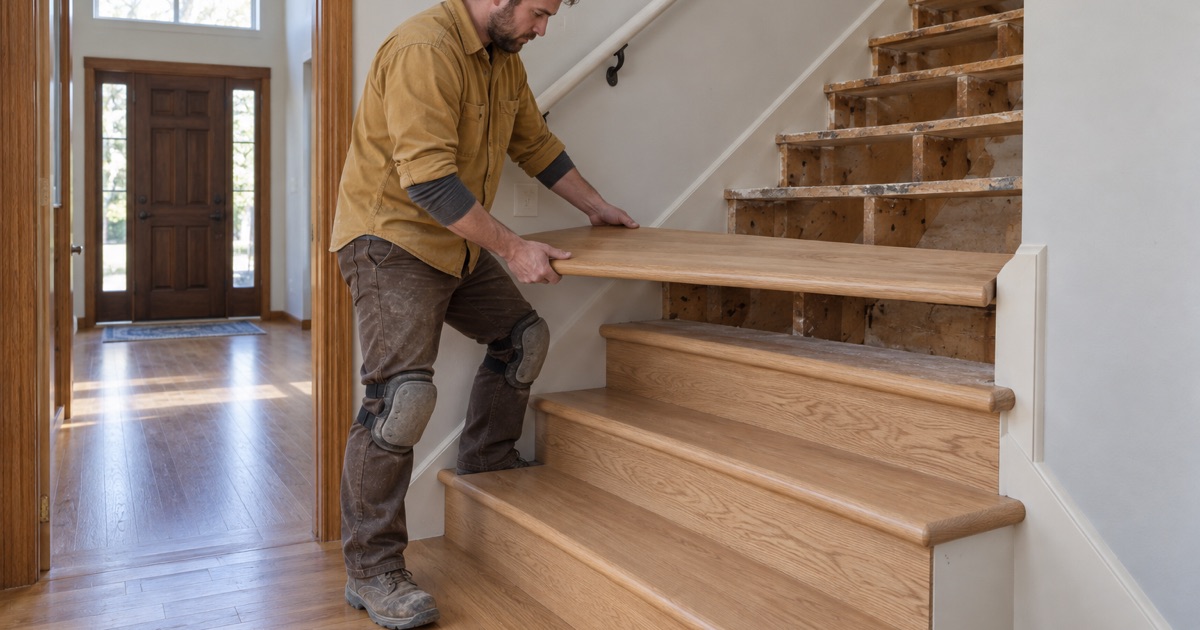
Treads, Risers and Nosings
The tread is the surface you step on, the riser is the vertical face between steps, and the nosing is the rounded front edge that overhangs. On a conversion each of those is new material, matched to the floor in species and finished to the same color and sheen. The nosing carries the most wear and takes the most abuse from shoes and vacuum heads, which is why its profile and its fastening are worth getting right rather than fast.
Stringers, Skirtboards and Returns
The stringer is the sawtooth framing the steps land on, and a skirtboard is the finished board covering it against the wall. Where a staircase is open on one side, each tread needs a return — a finished end cap that closes the exposed edge and makes the step read as a solid piece. Returns are slow, visible, and the single clearest tell between a staircase that was built and one that was covered up.
Carpet Removal and What Is Underneath
Pulling carpet off a staircase reveals one of two things. Either sound construction-grade treads that were never meant to be seen, which is the common case in houses of this era, or solid stock that can be sanded and finished directly. We look before quoting, because the first case is a capping or replacement job and the second is a refinish, and those are different numbers. Staples, tack strip and decades of adhesive come out as part of either.
Matching Stairs to the Floor
Species, Color and Sheen at the Transition
Stairs meet the floor at the top and usually at the bottom, and any mismatch is visible at both. Matching starts with species and cut, then finish. Because stair parts are a different cut in a different orientation, they absorb stain slightly differently from the field of a floor, so we sample on the actual stair stock rather than trusting a floor sample to predict it.
Retrofit Treads Over Existing Framing
A retrofit tread caps the existing step rather than replacing it, with a nosing that wraps the front edge. On a sound staircase built for carpet it is efficient, strong and keeps the rise and run exactly as they were. Where the framing is out of level, where the rise varies between steps, or where a tread flexes underfoot, capping locks that in permanently — so those staircases get the treads taken off instead.
Refinishing Stairs With the Floors
The cheapest time to do stairs is while the floors are being sanded, because the setup, the containment, the stain and the finish are already there and already paid for. Doing them a year later means paying for all of it twice and matching a color that has started to amber. When a floor refinish is quoted we put the stair number beside it, so the decision is made once with both figures visible.
Code, Landlords and Pricing
Handrails, Guardrails and the Rental Checklist
This city’s residential rental pre-inspection checklist is unusually specific about stairs. It calls for graspable and continuous handrails with returns, continuous guardrails on open sides of landings and stairways thirty inches or more above grade, a clear pathway, and floor covering that is intact and secured to the stairs. If the property is licensed as a rental, a stair project is the natural moment to resolve those rather than meeting them under inspection pressure.
Why Stairs Are Priced by the Tread
Each step is its own small piece of cabinetry: cut, fitted, fastened, hand sanded and finished. There is no open field to run a machine across, and a staircase with fourteen steps is fourteen of those operations plus returns, skirtboards and a landing. Pricing by the tread reflects what the work actually is, and it also makes two quotes genuinely comparable, which a lump sum does not.
Scheduling a Staircase Out of Service
A staircase is not a room that can be closed off. Where a house has only one, we plan around that: working in halves so one side stays walkable, sequencing the messy stages around a weekend, or staging the finish so the stairs come back before the floors do. The plan and the dates go on the quote, because finding out on the morning that the stairs are unavailable for three days is not a plan.
- 20+ Years Experience
- Written Price Per Square Foot
- Moisture Tested Before Quoting