
Maple Grove Wood Flooring has been recoating hardwood floors in Maple Grove, MN for more than 20 years, serving surrounding cities including Dayton, Brooklyn Park, Champlin, Corcoran and Plymouth. Recoating is the cheapest good decision available to anyone with a wood floor, and it is the one most people find out about after the window for it has closed.
The idea is simple. A finish is a sacrificial layer, and while wear is still confined to that layer it can be renewed without ever exposing the wood. Add a coat at the right moment and the floor is restored in a day. Wait until the traffic lanes have gone through to bare wood and the only remaining option is a full sanding, which costs several times as much and spends wood the floor can never get back.
So this page is really about two questions. Is your floor still inside the window, and will a new coat actually stick to what is already there. The first is a matter of looking at the floor properly. The second is where recoating goes wrong, and it is why we test before committing a room rather than after.
Knowing When a Floor Is Ready for a Recoat
The Window Before the Wood Is Exposed
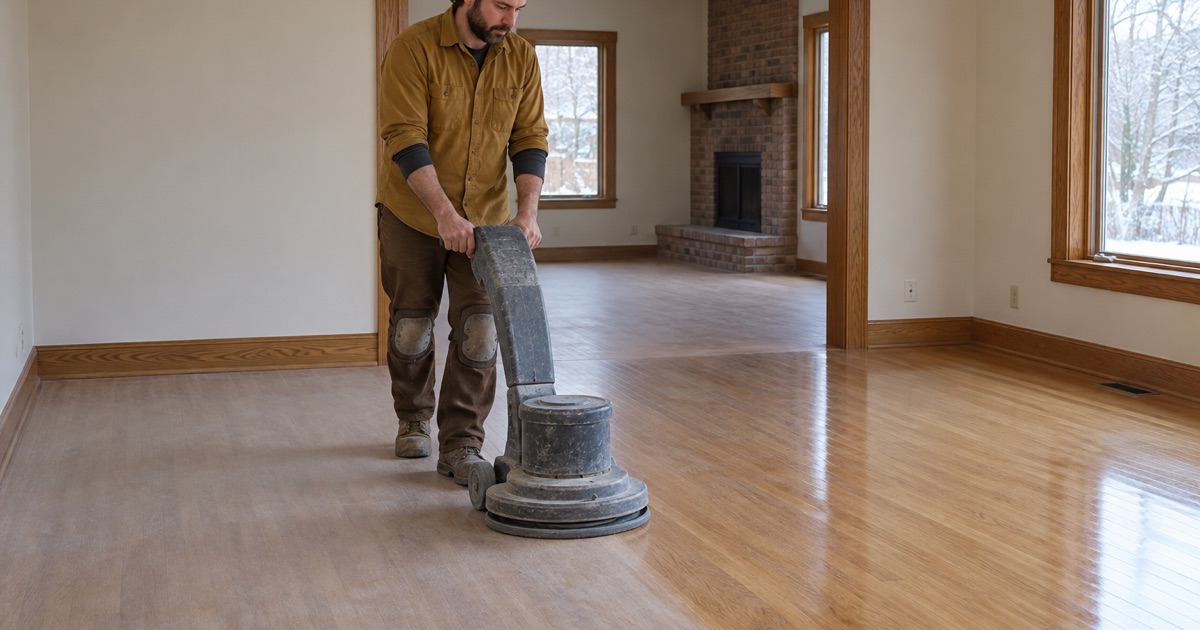
A floor inside the window shows dull traffic lanes, fine surface scratching and a sheen that has flattened in front of the sink and inside the door. The wood underneath is still sealed. Once gray, water-stained or bare boards appear, the window has shut and a coat will simply make the damage glossy. We check by looking at scratches in raking light and testing whether water still beads, rather than by asking how old the floor is.
Testing Whether the Existing Finish Will Bond
A new coat has to key into the old one, which means the old one has to be clean, abradable and free of anything that repels a finish. We abrade a small area, apply the intended product, and let it cure before touching the rest of the house. If it lifts with tape or peels at an edge, we have learned that for the price of an afternoon instead of the price of a whole floor.
What Rules a Recoat Out
Cupping, crowning, overwood at the board edges, a previous sand-through, peeling or delaminating finish, and any change of color all rule it out, because each needs bare wood. So does damage that has reached the fiber anywhere you care about. Paying for a recoat first in those cases does not reduce the cost of the sanding that follows; it adds to it, and we say so at the quote rather than at the end.
Contamination Is the Real Enemy
Acrylic Polishes, Waxes and Oil Soaps
The products sold to make a floor shine are the products that stop a finish bonding to it. Acrylic polish builds a film, wax leaves residue in every joint, and oil soap leaves a slick that survives ordinary cleaning. Abrasion takes off what sits on the surface and reaches nothing that has migrated into the seams. Stripping resolves some of it, and where it does not, the honest answer is a sanding.
Kitchens, Pet Areas and Silicone
Contamination is rarely uniform. Kitchens carry cooking oils, pet areas carry residue from cleaners, and any room where somebody has used a silicone-bearing polish has a patch that will reject a finish while the rest of the floor accepts it. That produces the worst outcome: a recoat that mostly works and fails in one visible area. We test in the rooms most likely to be contaminated rather than in the tidiest corner of the house.
How We Test Before Committing a Room
The test is small, deliberate and boring, which is the point. An abraded patch, the actual product, a proper cure, then an adhesion check. Where it passes, the room goes ahead with confidence. Where it fails, we have a specific reason and a specific plan, and nobody has spent a day coating a house that was going to peel by spring.
Recoating as a Maintenance Cycle
Setting an Interval for Your Floor
The right interval is a property of your household rather than of the product: entry doors, dogs, children, chairs, and whether shoes come off at the door. Rather than issue a number, we look at the floor and tell you roughly when to have it looked at again. A floor kept on a recoat cycle can go decades without a sanding, which is the whole argument for paying attention to it early.
Rentals, Common Areas and Turnover
A recoat between tenants is fast, cheap and finishes in a day, which fits a turnover window in a way that a sanding and cure schedule does not. It also addresses exactly what this city’s rental pre-inspection checklist asks of floors: in good repair, structurally sound, no trip hazards. For a licensed rental or an association common area, a scheduled recoat is usually the difference between maintenance and a capital project.
What a Recoat Costs Against a Full Sanding
A recoat is priced per square foot like any other floor work, at a fraction of a full refinish, with a minimum project size because setup costs the same either way. The number that matters, though, is the comparison. We put the recoat price and the sanding price side by side, along with an honest read on how long the recoat buys you, so the decision is made with both figures on the table.
- 20+ Years Experience
- Written Price Per Square Foot
- Moisture Tested Before Quoting